Heterodyne Kelvin Probe Force Microscopy
Heterodyne KPFM
Superior surface potential detection with high spatial resolution by frequency mixing away from cantilever resonance, reducing noise and topography crosstalk
What is Heterodyne KPFM (Heterodyne Kelvin Probe Force Microscopy)
Heterodyne KPFM measures surface potential and work function by employing a heterodyne frequency detection scheme that shifts the signal away from the cantilever’s resonance frequency, enhancing sensitivity and spatial resolution while minimizing mechanical and background noise.
Heterodyne KPFM utilizes a unique frequency mixing approach to separate the contact potential difference (CPD) signal from mechanical noise and resonance artifacts. By applying an offset frequency, the technique detects CPD at the difference between the cantilever’s resonance frequency (f₀) and the modulation frequency (f₁), confining measurement to a noise-free region and enabling localized, high-resolution signal acquisition. This heterodyne effect dramatically enhances sensitivity and spatial resolution for surface potential mapping, providing clean signal isolation even in challenging environments.

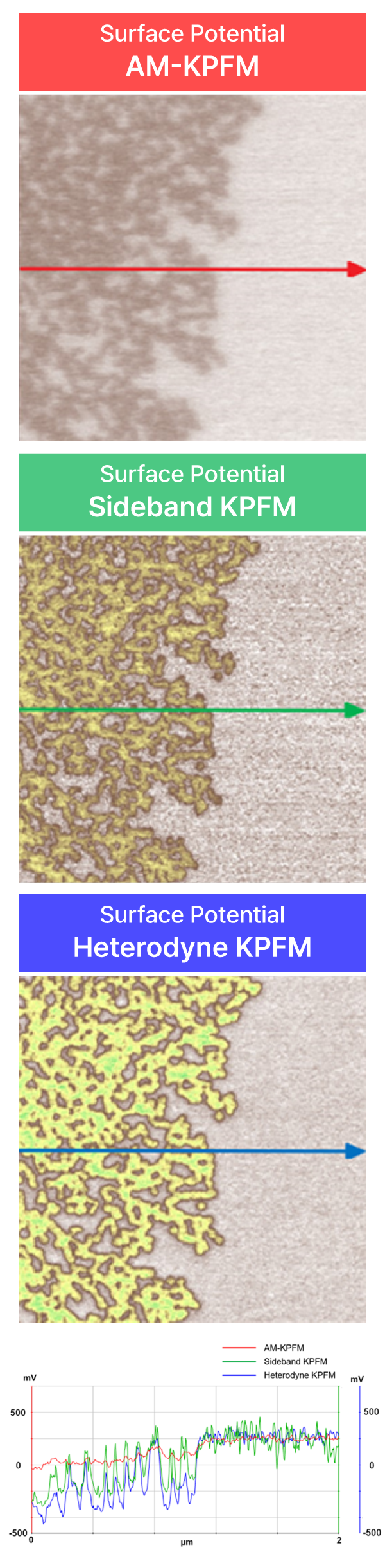
Compared to earlier methods, amplitude modulation (AM)-KPFM measures electrostatic forces at a fixed frequency but is hampered by noise and lower resolution due to overlapping mechanical interferences. Sideband KPFM, though more advanced, detects CPD at multiple sideband frequencies, partially mitigating these issues but still susceptible to frequency crosstalk. Heterodyne KPFM’s strategy of completely shifting CPD detection away from resonance allows for superior noise immunity and precision, outperforming both AM-KPFM and sideband techniques in resolving nanoscale electronic inhomogeneities
Reasons to Use This Mode
The comparative evaluation of AM-, Sideband, and Heterodyne KPFM modes demonstrates the value of advanced detection schemes for high-resolution surface potential mapping. AM-KPFM, influenced by long-range electrostatic forces across the cantilever, suffers from low spatial resolution and poor sensitivity to nanoscale features. Sideband KPFM improves upon this by focusing on the localized electrostatic force gradient at the tip apex, delivering enhanced mapping of nanoscale potential variations between molecular domains. Heterodyne KPFM further advances performance by isolating the detection frequency from mechanical noise, achieving the highest spatial resolution and precision. This makes Heterodyne KPFM the preferred technique for accurate nanoscale surface potential measurement and quantitative analysis of complex materials.
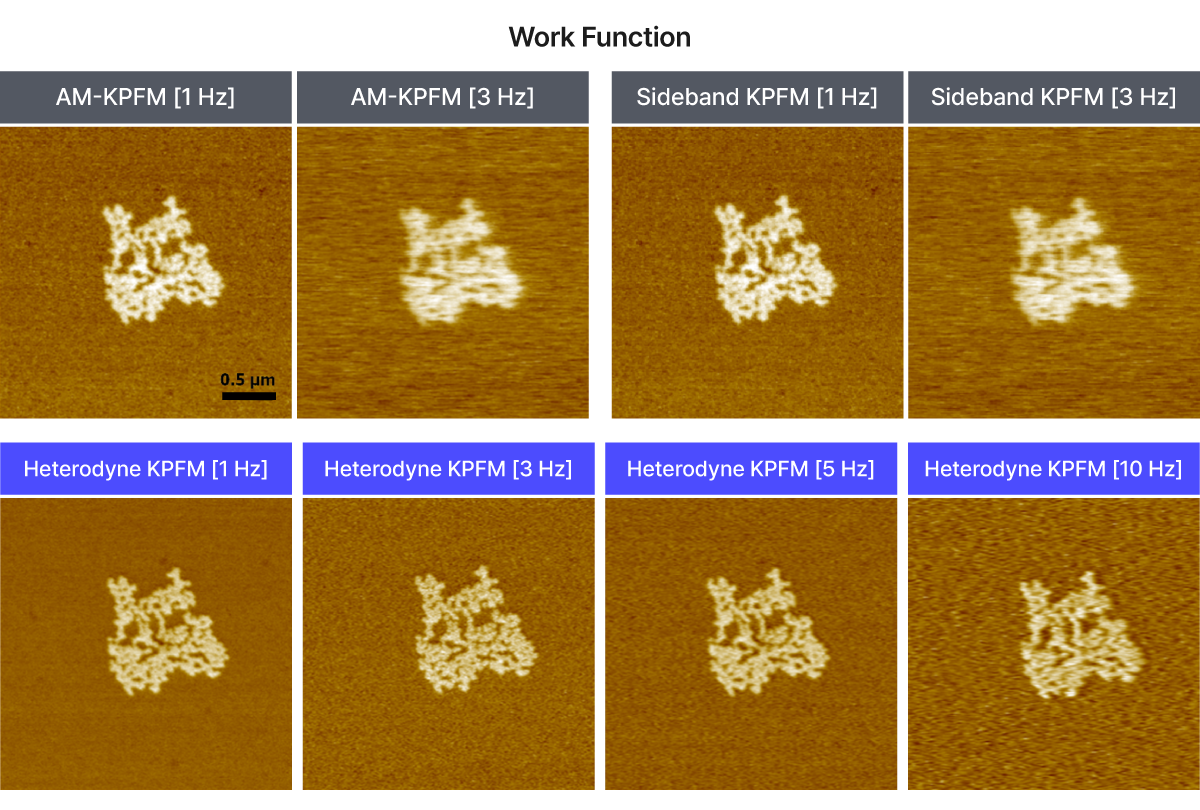
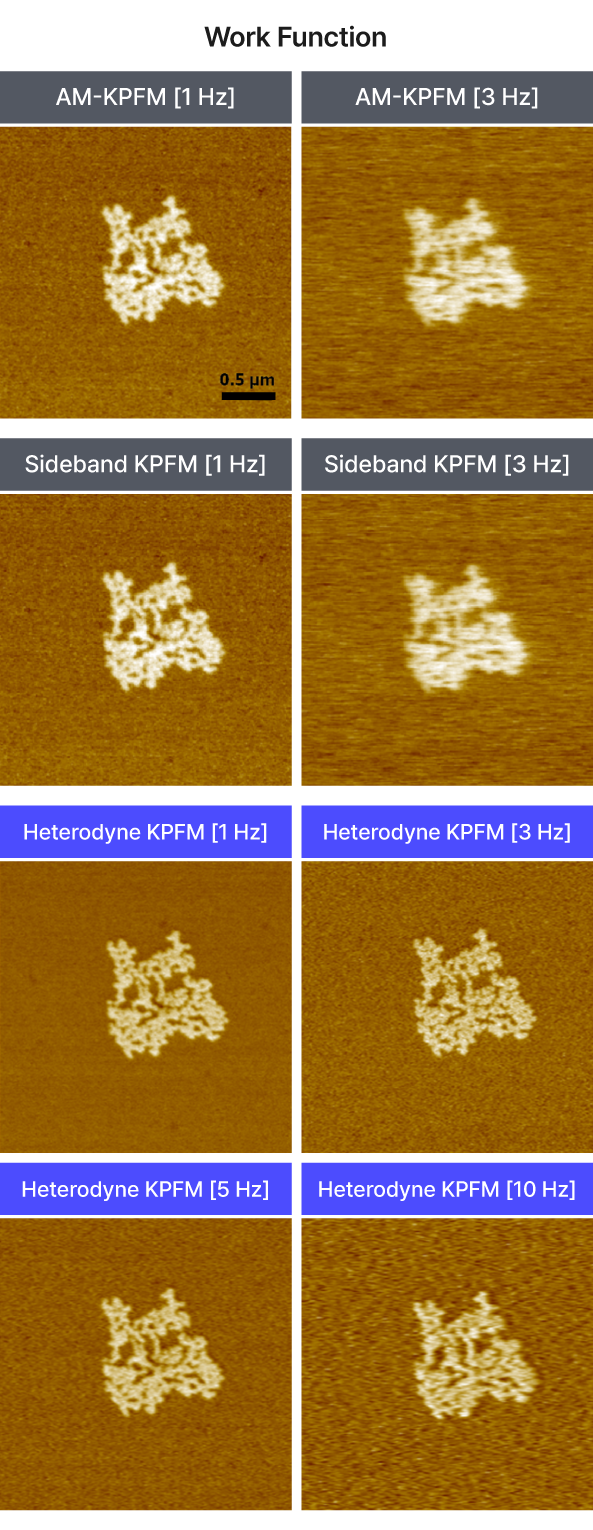
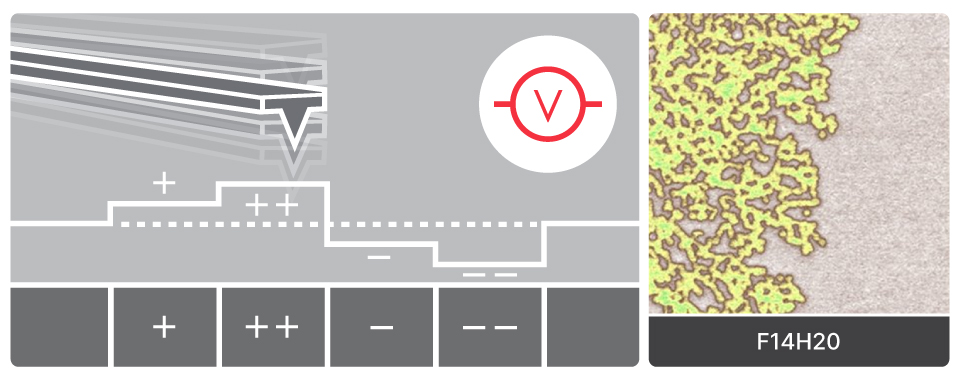
One of the notable advantages of Heterodyne KPFM is its robust performance at high scan speeds, as demonstrated in the attached images. While AM-KPFM is easy to implement, it suffers from lower spatial resolution and significant image degradation at elevated scan rates due to topography crosstalk and the limitations of its feedback system. Sideband KPFM offers improved spatial resolution and sensitivity by capturing the electrostatic force gradient, but still encounters feedback constraints that restrict its effectiveness at higher scan speeds. In contrast, Heterodyne KPFM decouples detection from the cantilever’s resonance and feedback bandwidth, enabling rapid acquisition of reliable surface potential data without substantial loss in image quality. As scan speeds increase from 1 Hz to 10 Hz, Heterodyne KPFM consistently produces high-fidelity work function maps, maintaining superior image quality where other modes fail. This capability makes it ideal for dynamic experiments and high-throughput nanoscale potential mapping.
  • Sample: F14H20
  • System: FX40
  • Scan Size: 3 μm×3 μm
Applications and Use Cases
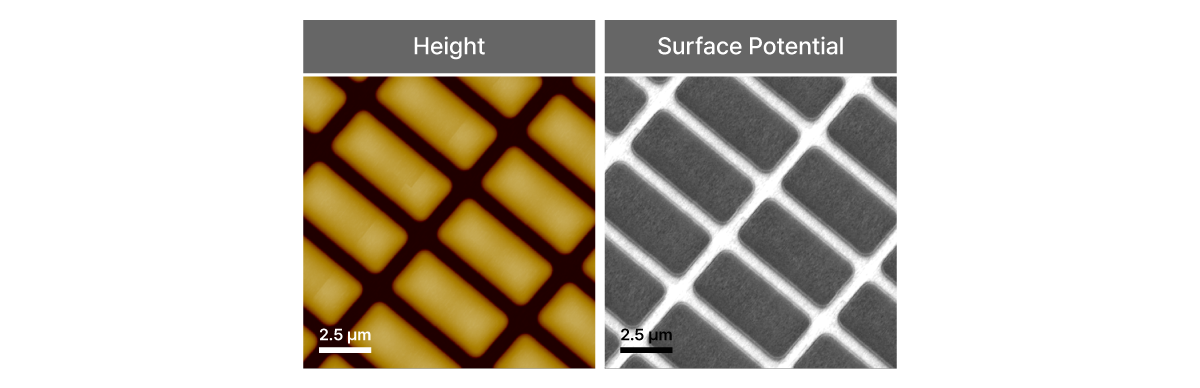
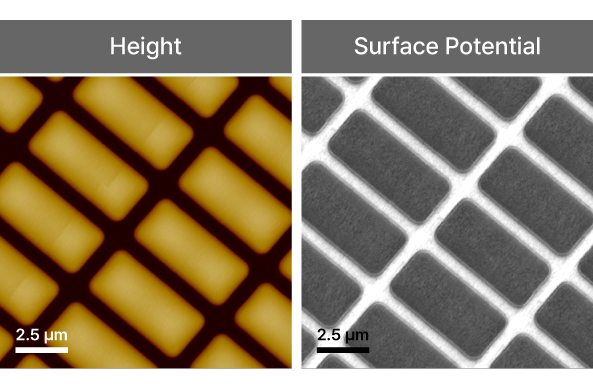
Heterodyne KPFM excels in the nanoscale characterization of patterned wafer surfaces by providing simultaneous topographical (height) and surface potential images. The height image reveals the physical structure and periodicity of the wafer pattern. The heterodyne KPFM potential image, in contrast, captures electronic property variations with high sensitivity, clearly highlighting differences in local surface potential. This result enables a comprehensive understanding of both the morphological and electronic heterogeneity of wafer patterns, supporting advanced device engineering, process monitoring, and defect analysis in semiconductor manufacturing.
  • Sample: Patterned Wafer
  • System: FX200
  • Scan Size: 14 μm × 14 μm