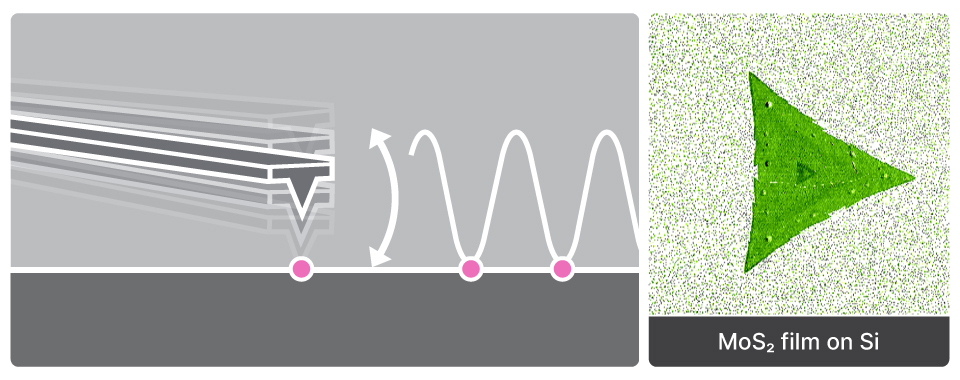
Tapping Mode measures surface topography by vibrating the cantilever near resonance and detecting changes in oscillation amplitude during brief tip-sample contacts, offering relative mechanical property differences of the sample.
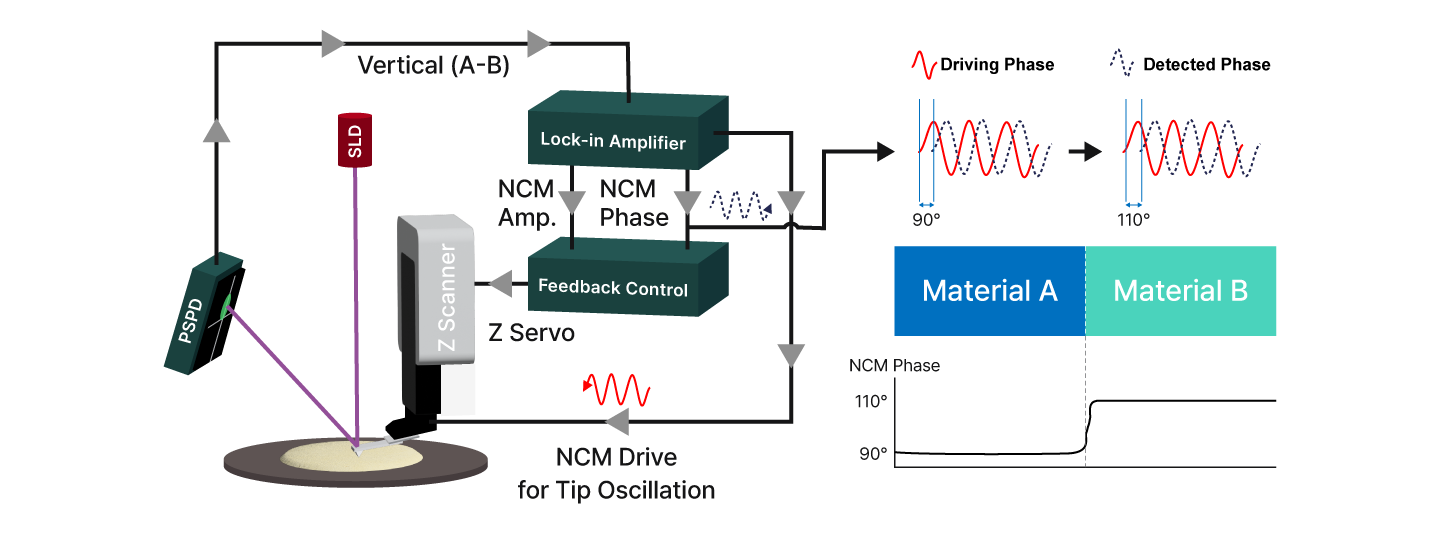
Tapping mode utilizes cantilever oscillation near resonance frequency, intermittently contacting the sample surface to achieve high-resolution topography while minimizing lateral friction forces. The amplitude changes as tip-sample distance and interactions vary, with feedback actively maintaining constant amplitude via Z scanner adjustment—Z position thus representing the sample’s topography. Tapping phase contrast reveals differences in viscoelasticity, adhesion, and stiffness between materials. While this approach is gentler than contact mode, intermittent contact can still degrade delicate tips or soft samples over time. The technique reliably distinguishes relative mechanical properties between regions, as illustrated by phase shifts observed for materials A and B in the schematic.
Reasons to Use This Mode
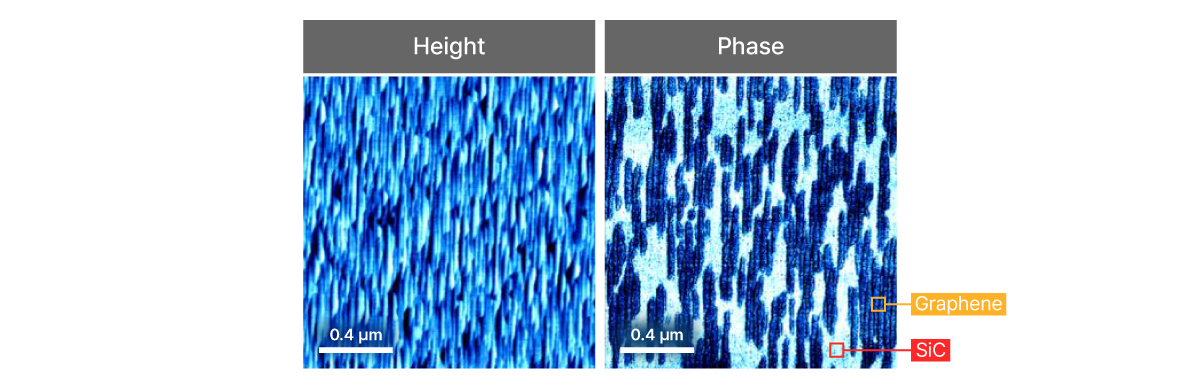
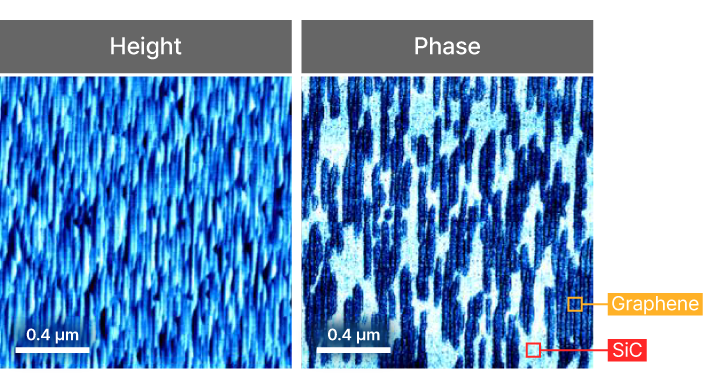
Tapping mode excels in distinguishing materials with similar surface topography by leveraging phase imaging sensitivity to mechanical properties. In the figures, graphene flakes on a SiC substrate are indistinguishable in the height image, but clearly separated by phase contrast. Phase imaging by Tapping mode reveals material-specific viscoelasticity and adhesion differences, enabling effective identification and mapping of graphene versus substrate regions without relying on topographic variation. This exemplifies the value of tapping mode for studying composite nanostructures and material distributions at the nanoscale.
Sample: Graphene on SiC
System: NX10
Scan Size: 1.5 µm × 1.5 µm
Applications and Use Cases
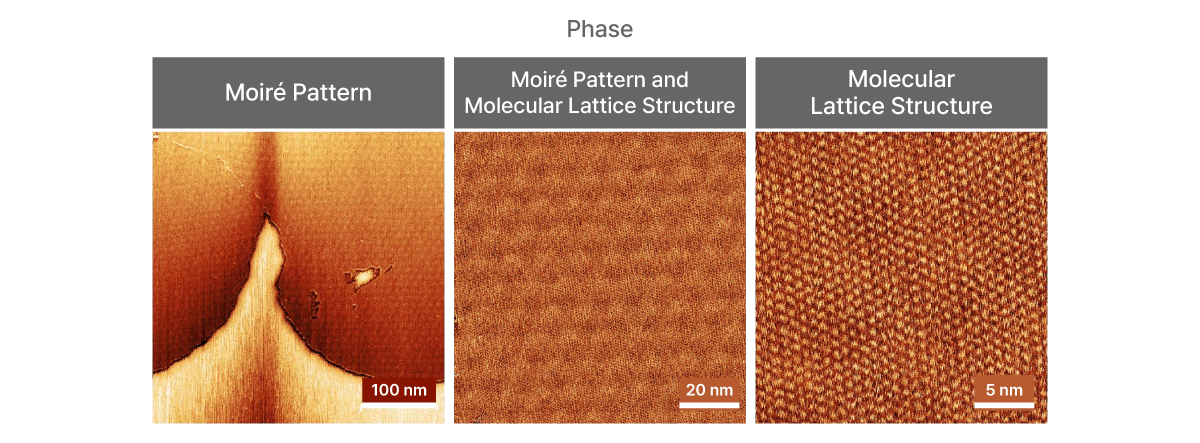
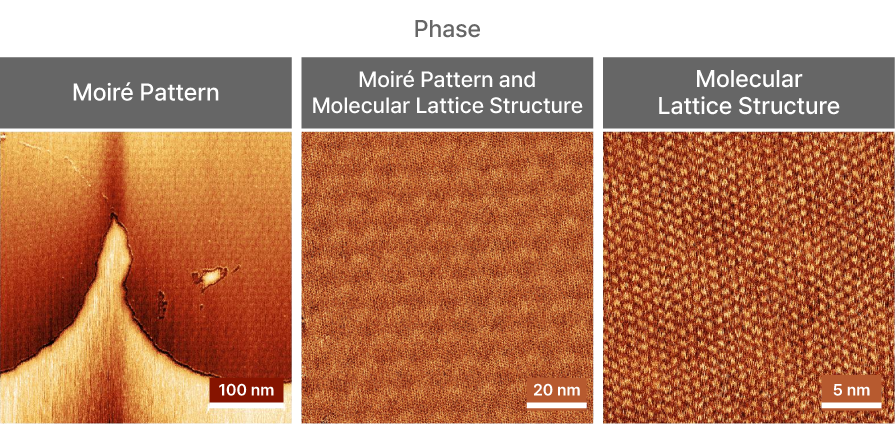
The phase images capture the co-adsorption of melamine and cyanuric acid on an atomically flat HOPG surface, revealing a 2D molecular network with a distinct periodicity of 0.98 nm. Due to lattice mismatch between the molecular network and the underlying HOPG substrate, a Moiré pattern is visualized alongside the lattice structure. This demonstrates Tapping mode’s unique capability to resolve both molecular arrangements and superstructure modulations critical for nanostructure engineering and materials science.
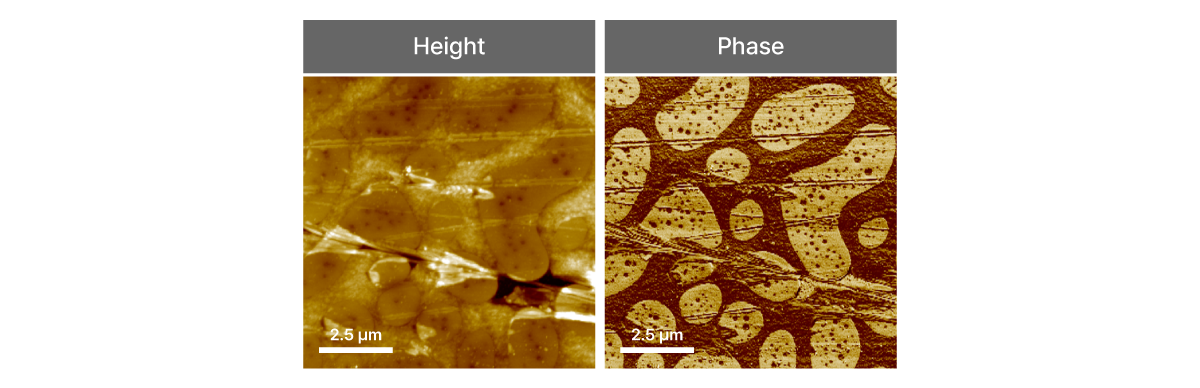
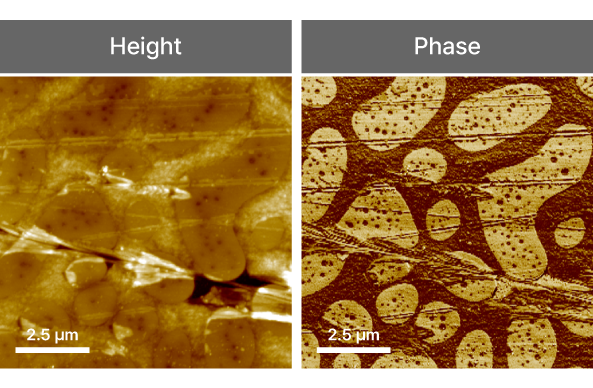
Tapping mode is ideal for studying complex polymer systems, such as blended polystyrene and polyvinyl acetate (PS-PVAc) films. As shown in the images, phase imaging in Tapping mode distinctly reveals nanoscale domain morphology and phase separation in the polymer blend, which is not apparent in the topography data. This enables precise identification of individual polymer components, mapping their distribution and mechanical property contrast, thus supporting advanced research in polymer physics, material engineering, and nanocomposite optimization.