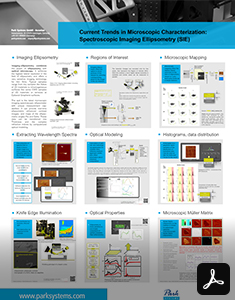
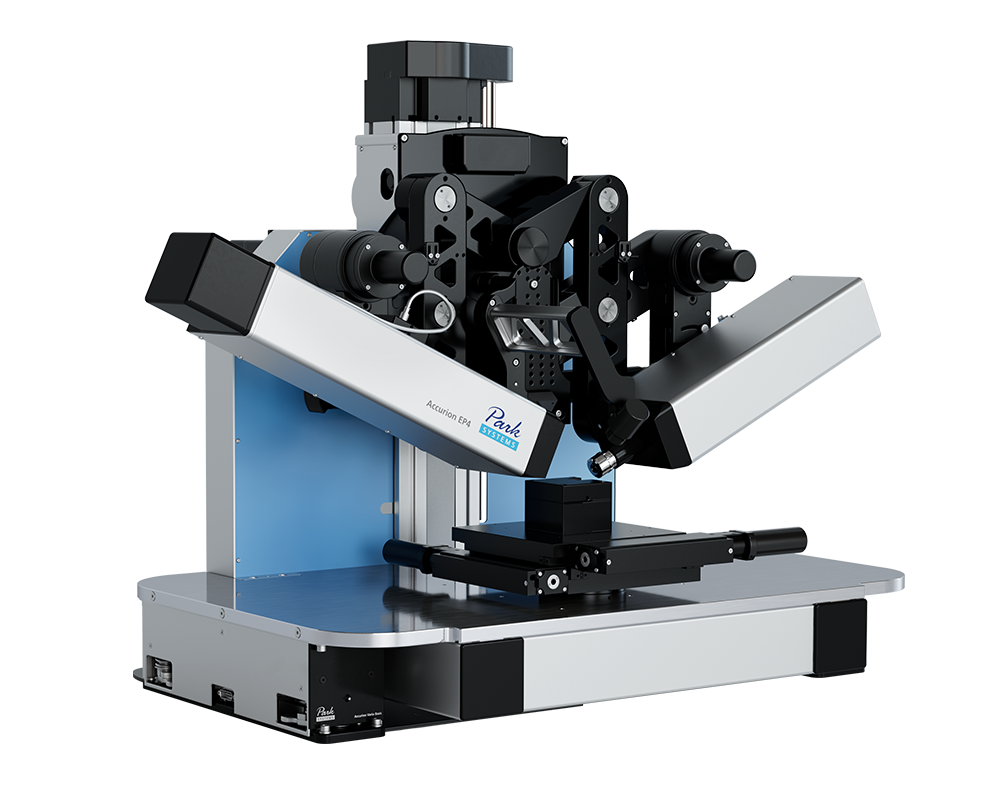
Park Systems Accurion EP4 imaging ellipsometer combines ellipsometry and microscopy for precise thickness and refractive index measurements on micro-structures

Accurion EP4

Our Latest Generation of Imaging Ellipsometers Combines Ellipsometry and Microscopy

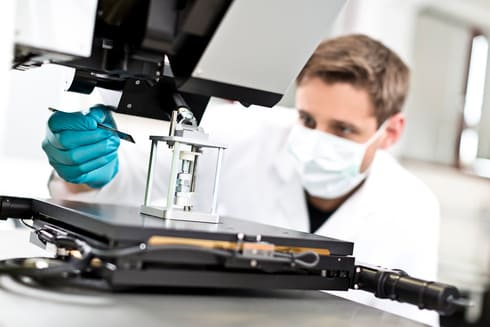
Accurion EP4 is a high-end system for Imaging Spectroscopic Ellipsometry, combining spectroscopic ellipsometry and optical microscopy in a single instrument. It enables spatially resolved, parallel measurement of film thickness and refractive index on micro-structured samples with lateral resolution down to 1 µm, featuring live ellipsometric contrast imaging and direct selection of regions of interest for quantitative analysis.

The Microscopic Way of Doing Ellipsometry

Simultaneous Ellipsometry on Every Pixel

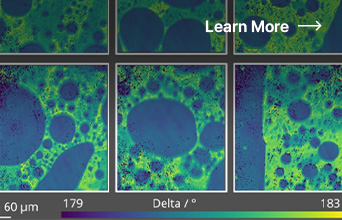
In the EP4, imaging spectroscopic ellipsometry is performed in parallel across the entire field of view. No scanning or sequential single-point measurements are required.

Highest Lateral Ellipsometric Resolution

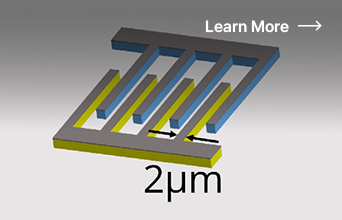
With lateral ellipsometric resolution down to 1 µm, the EP4 enables precise film thickness and refractive index measurements on even the smallest inhomogeneous and micro-structured features.

First Identify, then Measure

The principle “First identify, then measure” enables intuitive selection of regions of interest directly from the live ellipsometric image.

Continuous Spectroscopic Imaging

Continuous spectroscopic imaging from UV to NIR ensures comprehensive optical characterization across the relevant spectral range.

Key Features

  • Microscopic lateral resolution down to 1 µm, enabling precise determination of film thickness and refractive index on micro-structured samples.
  • Sub-nanometer vertical sensitivity for highly sensitive detection of ultra-thin layers, including mono- and sub-monolayers.
  • Imaging Spectroscopic Ellipsometry (across UV–VIS–NIR), with a configurable spectral range from 190 nm to 1700 nm.
  • True parallel multi-pixel measurement, performing spectroscopic ellipsometry simultaneously on every pixel within the field of view.
  • ROI-based measurement workflow (“First identify, then measure”), allowing intuitive selection of measurement regions directly in the live ellipsometric view.
  • Live ellipsometric contrast imaging for real-time visualization of thickness and optical inhomogeneities.
  • Automated sample stage control with large-area stitching, enabling measurements over extended sample areas.
  • Knife-edge illumination for non-destructive suppression of backside reflections on transparent substrates.
  • Modular optical design with interchangeable objective lenses, allowing adaptation to different measurement tasks.
  • User-friendly EP4 software suite (EP4Control, DataStudio, EP4Model) for instrument control, data analysis, and optical modeling.
  • Active vibration isolation ensuring superior mechanical stability for high-precision measurements.
UsingImaging Spectroscopic Ellipsometrywithmaterial

The Accurion EP4 redefines imaging ellipsometry by combining Imaging Spectroscopic Ellipsometry, optical microscopy, and spectroscopy in one powerful metrology platform. It delivers precise thin-film metrology and refractive index measurement on microstructures as small as 1 µm, making it ideal for advanced surface characterization and microstructured sample analysis.

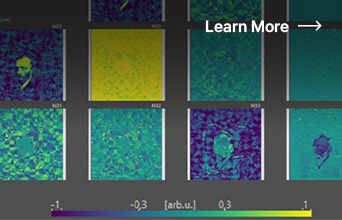
The modular EP4 software suite enables intuitive instrument control and online or offline analysis of imaging ellipsometry data through dedicated software modules. EP4Control handles instrument operation and measurement execution, including the definition of measurement parameters and Regions of Interest (ROI) directly in the live ellipsometric view, as well as the acquisition of ellipsometric maps. DataStudio provides tools for visualization and processing of measured data, including map calculation and analysis, spectral clustering, histogram analysis, and cross sections for detailed spatial and spectral evaluation. EP4Model supports optical modeling of thin films and multilayer stacks, enabling the determination of film thickness and optical constants (n, k). Advanced features include effective-medium approximations, modeling of anisotropic materials based on Mueller matrix elements, and access to a comprehensive material database.

Applications

2D-Materials

2D-Materials

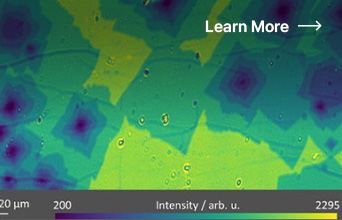
Imaging Spectroscopic Ellipsometry enables precise characterization of graphene and other 2D materials. CVD-grown, exfoliated, and epitaxially grown flakes are analyzed with spatially resolved thickness and optical property determination.

Surface Engineering

Surface Engineering

In surface engineering, imaging ellipsometry is used to study silanization and surface modification processes bonding inorganic and organic components. It enables label-free analysis of layer formation on structured surfaces and arrays.

Photonics

Photonics

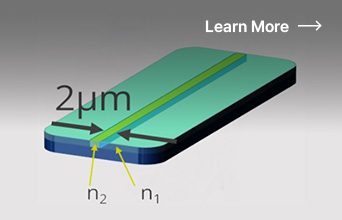
In photonics, spectroscopic ellipsometry measures optical fibers and waveguides with 1 µm lateral resolution. The spectral range from 190 nm to 1700 nm provides accurate optical data for development and quality control.

Displays

Displays

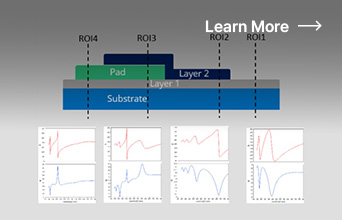
For display materials, the ROI concept enables spectroscopic measurements on micron-scale regions. The UV range down to 190 nm allows precise determination of film thickness, dispersion, and composition with short cycle times.

MEMS

MEMS

The EP4 characterizes MEMS structures down to 1 µm with sub-nanometer thickness resolution. A single measurement provides film thickness, refractive index, composition, and contamination, with ECM modes enabling fast quality control.

Transparent Substrate

Transparent Substrate

Thin films on transparent substrates are essential for flexible displays and optical devices. Knife-edge illumination suppresses disturbing backside reflections, enabling non-destructive and artifact-free measurements.

Battery Materials

Battery Materials

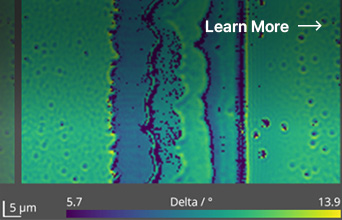
Operando imaging ellipsometry tracks battery electrode materials during charging and discharging. Microscopic Δ and Ψ maps provide spatially resolved information, supported by profile, sub-region, and histogram analysis.

Anisotropic Films

Anisotropic Films

Imaging Mueller Matrix Ellipsometry (IMME) enables complete optical characterization of anisotropic thin films and microcrystals. Spatially resolved determination of refractive indices and optical axis orientation is achieved, for example in black phosphorus.

Curved Surfaces

Curved Surfaces

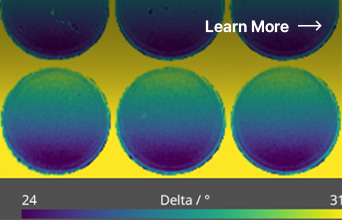
The EP4 measures thin films and anti-reflection coatings on flat and curved surfaces. Imaging ellipsometry enables spatially resolved evaluation of coating uniformity and defects, particularly on micro-lens arrays.

Bio Interfaces

Bio Interfaces

Imaging ellipsometry provides high sensitivity for mono- and sub-monolayer films at bio-interfaces. Micromaps of ellipsometric angles and contrast modes capture dynamic thickness changes, supported by accessories such as flow cells or QCM-D.

Air-Water Interface

Air-Water Interface

At the air–water interface, Brewster Angle Microscopy (BAM) visualizes Langmuir–Blodgett monolayers and biological materials. Molecules, proteins, drugs, DNA, and nanoparticles are investigated in situ and in real time.